Showing posts with label Training. Show all posts

Monday, July 27, 2015

Work Session Best Practices (aka Meetings)


This document was created for our employees to understand how our work sessions operate so that each shows up ready to collaborate and well-prepared with the tools for an effective a work session.  We are sharing it here in case it inspires anyone else on ways to set up their meetings to be more effective.  We continuously update this best practice to improve the way our meetings work.   


We call our meetings Work Sessions.  Work Sessions are optimized meetings that make more efficient use of all attendees’ time.  They facilitate more rapid decision making and empower collaboration.  With the use of this system, all participants are aware of their individual role during the work session, are well prepared to make most efficient use of the time, are focused on what is important, contribute toward solving challenges, and clearly know the desired outcome. 


The Process


For any work session to be successful, group collaboration is required. 


Roles


·       Project Leader – The person responsible for managing the completion and organization of the work as well as ensuring the outcome is achieved wears the hat of the Project Leader.  The more involved the Project Leader is in the work session process, the more successful the outcome will be. 

·       Coordinator – The person responsible for providing administrative support to the Project Leader wears the hat of the Coordinator.  The Coordinator works closely with the Project Leader to provide assistance, take meeting minutes, follow up on progress, and make sure all steps in the Work Sessions Best Practice are completed.

·       Contributor – A contributor prepares documentation (as assigned), updates their assignments in Workfront, and offers input based on expertise.

·       Stakeholder – A stakeholder attends the meeting to participate in the discussion and offers input based on their expertise. [Typically Program Managers and/or Functional Managers]

·       Reviewer – A reviewer reviews the recommendations and work to approve or discuss what is needed for approval.  [Typically Managers, Directors, President, and/or CEO]

The Project Leader and the Coordinator shall utilize the Work Session Checklist to ensure all steps are taken care of.  This tool can be used to help decide who is responsible for what for each work session.  The Coordinator is responsible for working with the Project Leader and making sure every item is tended to on the Work Session Checklist for every work session.

Additional roles are important as well.  What is most important is that each role is clearly identified in the work session invitation so everyone knows why they are there and what they are expected to contribute.  Standardized roles are defined in the Work Session Form Template.


The Basics


Please note that all work sessions require documentation.  No work session should ever be scheduled without some type of well-prepared document to review.  The intention of a work session is to review content that was prepared beforehand, is documented in a clear and effective manner, and to collaborate to achieve an ideal outcome, determine next steps, or to get direction from a superior. 


The Coordinator should review all documentation meets the standards as requested per the last work session (if applicable) before the work session begins.  If the documentation specifically requested last work session is not ready, the Coordinator is to advise the person responsible for the documentation on how to improve it and also notify the Reviewer that the work session is not prepared.  It is up to the Reviewer to determine if they want to reschedule the meeting. 


Step 1: Make the Agenda [Coordinator]


Before doing anything else, draft the agenda.  The agenda is often very simple but having an optimized agenda will ensure effective use of time and is required for every work session.  The agenda will detail key points that are to be discussed and help participants come prepared.  Work with the Project Leader to prepare the agenda.


Before you can create an effective agenda, you must know who will be attending the work session.  You want to make sure all of the right people are in the room to help create the best decision with unique insights.  Identify who will be impacted by the decisions that are being made – both downstream and upstream.  Confirm with the Project Leader that all participants are included that need to be.  Every agenda should always include an opportunity for feedback from the team as well as an agreement about the deliverables (in SMARTER format) to have ready for the next work session and when to meet next.


Suggested Agenda (to be customized per work session needs):


1.     Review Progress on Previously Assigned Deliverables.  Each work session should begin with reviewing progress on the deliverables from the previous work session, if applicable.  Paste the deliverables into the agenda and attach any associated documentation right next to each deliverable in the same order. 

2.     Gather Feedback. After each deliverable is reviewed, all participants have an opportunity to provide insights or feedback on the deliverables themselves.  Feedback is captured via the Work Session Notes so that the deliverables will be updated with the team’s feedback.

3.     Review the Status of all other Pending Items.  Look at the overall Action Plan to confirm all items are progressing as needed.  Discuss anything that is held back and when it can be expected to be done.

4.     Confirm When to Meet Next and Deliverables to Review Then.  The group shall discuss when the next set of deliverables will be ready for review, what should be focused on next, and when to schedule the next work session.

5.     Set the stage.  All of the big picture information should be included in the agenda for continuous clarity.  There is no need to discuss it each time but it should always be visible for everyone to see in the invitation.

a.     Why the work session or project is taking place

b.     The desired outcome(s)

c.      The participants’ roles and responsibilities

Step 2: Prepare Your Documentation [Project Leader]


The intention of a work session is to review content that was prepared beforehand and is documented in a clear and effective manner, discuss progress that was made, collaborate on an ideal outcome and/or next steps, or to get direction from a superior.  Each work session will have different documentation.  All documents must have enough content to review and have clear prioritization with visibility into the background process.


The documentation for a Work Session varies depending upon the content.  Suggestions:

1.      If deliverables were assigned that need to be reviewed, insert the documents that were created per the assignments. 

2.      For each work session, include the Work Session Form and its Action Plan unless this is a first meeting in a series or a single meeting to focus on reviewing one document.  Instructions on How to Create or Edit a Work Session Form are located in SharePoint.

3.      If the work session is to solve a problem, a PowerPoint presentation is a great way to reframe the problem into an ideal, Measurable Outcome and detail customized solutions for our company in a clear manner. 

4.      Sometimes a spreadsheet with formulas is helpful to attach as well.  That way, the reviewer can test formulas and shift models easily.

Note:  Google Drive is recommended for documents that will be edited by multiple people so that edits can be made at the same time during the work session.  Ideal documents to utilize the Google Drive include:

·        Work Session Forms

·        PODs that are being developed

For more information on how to utilize Google Drive, please review Google Docs – How to Upload.  Also please note that we do have a Shared Google Drive.   Login info is limited to Coordinators and Project Leaders to provide some control over documents.


Step 3: Schedule the Work Session [Coordinator]


Only once you have all of the above completed, schedule the work session by sending an invitation from Outlook.  It is ideal to set work sessions a day or two out so that all attendees can prepare properly and have enough time to ensure they got the message.  If a work session needs to be rescheduled, please be sure to do it at least 30 minutes prior to the start to avoid wasted time of people waiting for attendees (preferably at least two hours ahead so people can plan their work accordingly). 


Step 4: Send Reminder the Day Prior [Coordinator]


Send the Work Session Preparation Email Template or a similar reminder to all attendees the night prior to the work session to prompt updates in Workfront of the specific tasks and ensure preparedness for the work session.  Updates are due the following morning.  Modify the message as needed. 


It is ideal that all contributors post status updates in Workfront by the end of day on the day prior to the scheduled work session and send updated documents to the team.  This gives the Coordinator sufficient time to update invitation and provide a brief description of “Progress Since Last Work Session” on the Work Session Form.  If updates are not made by the end of day on the day before a work session, they need to be emailed directly to the Project Leader and CC’d to the Coordinator.  All updates are due at least two hours prior to the scheduled work session.  If documents are not received at least two hours prior, the work session may be delayed.


Step 5:  Final Preparation for the Work Session [Coordinator]


Make sure that updates are in from all contributors at least two hours prior to the work session.  If attendees are not prepared, the work session should be pushed out if possible.  Get all updates into the Outlook Invitation at least one hour prior to the start of the work session to avoid delays which may affect others and ensure receipt.


Coordinator is to review documentation and compare it against the previous Work Session Notes to ensure it is to the standards as requested in the last work session.  If the documents are not prepared as requested, the Coordinator is to advise the Reviewer. The Reviewer will decide whether to reschedule the work session or review what is ready so far.  To update the Work Session Form, follow the process outlined in the document How to Create or Edit a Work Session Form.


One Hour Prior: Send Out all Work Session Materials via Updated Outlook Invitation


All documents, the WSF, and the Outlook Invitation must be finalized at least one hour prior to the start of the work session to avoid delay in receipt and miscommunications.

1.      Review the quality of documents before work sessions and ensure they fit all the previous requests per the last Work Session Notes.

2.      Make final update to Outlook Invitation (see examples in Step 3). 

a.      Put documentation in the same order as the tasks are listed in the Action Plan on the WSF.

b.      If there is a WSF, be sure it is updated in the invitation to show progress since last work session.

Project Leader is to oversee that updates are input correctly and all information is given to Coordinator.  If any information is missing, Project Leader is to encourage updates by the team.


Step 6:  Conduct the Work Session


Coordinator’s Role During the Work Session


While in the work session, the Coordinator will watch the agenda and make sure the agenda is progressing.  The agenda for any project should always start with reviewing the progress on the previously assigned deliverables.  The Coordinator will take notes in the Work Session Notes template.  See How to Take Work Session Notes for more information.


If the work session goes over in time, the Coordinator is to communicate this to the team.  A 5-10 minute notice is advised.  Prior to the close of the work session, the Coordinator is responsible for confirming when the next work session date should be and what key deliverables they expect ready when they meet next.  The group is to agree to a reasonable time frame and deliverables.  This information should be added to the Work Session Notes.


Capturing Feedback is Essential


After each topic discussed, time should be given for feedback.  Work sessions should focus around solicitation of feedback rather than a presentation for 90% of the work session with a little time left for response. 


Capturing the feedback is critical and must be well thought out in advance.  For work sessions where participant feedback is critical, each participant should either bring a note sheet or an excel document to insert feedback on each aspect presented on the spot and give to the Coordinator to compile results. All feedback should be sent ASAP to the Coordinator so that the info can be added to the Work Session Notes.


Step 7:  Follow Up   


After the work session, be sure to do the following:


Refine and Send Work Session Notes.  [Coordinator]


1.      Refine the Notes.  Be sure they flow properly and rearrange if needed.  Organize via a numbered list in a manner that is most easy to follow.  Check for spelling and opportunities to make them clearer.  Bold key items.  Be sure documents are referred to by specific title and version if applicable.

2.      Bring down all Deliverables.  Review all notes and make sure all deliverables are moved down to the deliverables section and are listed in a SMARTER format. 

3.      Post Full Work Session Notes in Workfront.  Post the full Work Session Notes in Workfront directly in the main Project on the Updates tab.  Insert notes directly into the status update of the task rather than attaching. [Do not post if contains confidential information]

a.      Double check that the full notes are posted.  If they were cut off due to a character limit, paste the rest as a comment to it.  Repeat as needed.

                                                    i.     If tasks are discussed which fit in a different project than the main project that was being discussed, be sure to update the status of the appropriate project as well.  If needed, create the task or project.  Be sure to use SMARTER format.

Update the Work Session Form.  [Coordinator]


1.      Update the Action Plan of the Work Session Form.  Add new deliverables and updates received during work session.

a.      Hyperlink Action Items to WorkfrontTasks.  Be sure that each Reference # of each sub-task listed in the Action Plan section of the Work Session Form is hyperlinked to the associated Task in Workfront.

b.      Update Workfront assignments if updates are not showing as discussed in the meeting.

c.      If needed, create tasks that are not already created.  Be sure to search to ensure any new tasks have not already been created to avoid duplication and disorganization.  Create them in SMARTER format. Input a SMARTER description, planned hours, due date, and assignee. 

Distribute Work Session Information to All Attendees.                                                               [Coordinator]


1.      Send an email with the Work Session Notes and Updated Action Plan to all Attendees.  Attach the Work Session Notes document, paste the notes in the body of the email as well for ease of review, and paste the updated Action Plan at the bottom of the email.  Send this email to attendees as soon as possible after the work session – by the latest – the following day after it.  Many people rely on the details in this message so sending this as soon as possible facilitates the team being able to advance.

2.      Make sure to save a copy of the Work Session Notes in the Meetings Folder on SharePoint.

Review Updated Tasks in AtTask.  [Project Leader]


a.      Review that new tasks are set up properly, have a SMARTER description, the correct amount of planned hours, appropriate due date, and correct assignee. 

Schedule Follow Up Work session.  [Coordinator]


1.      Schedule the next work session right away – as part of the close out process – to ensure it is in the calendar and not forgotten.  See steps 1-3 in this Best Practice to create the agenda, documentation, and invitation needed.

2.      Double check the Work Session Checklist to confirm that all steps were completed.  Send confirmation to the Project Leader.

Additional Follow up [Coordinator]


1.      Work with the Project Leader/Contributor(s) to update the Action Plan items as needed, ensure that the entire Work Session Checklist is followed, and oversee that the overall progression is moving along as quickly as possible . 

2.      Keep an overall eye on deliverables and help them progress.  Update deliverables in WSF prior to any future work session to allow them to move quickly. 

3.      Every week make sure all required work sessions are scheduled and all prior deliverables are moving forward.  Keep copies of one-off Work Session Notes in your tickler folder in Outlook with a reminder to ensure you check on them monthly, or more often as needed.

Please note we also have a Work Session Checklist which should be utilized for each work session by the Project Leader and Coordinator to ensure all appropriate steps are followed.  It is available in the Knowledge Center on SharePoint under Shared Documents.

Wednesday, May 27, 2015

Guidelines for Research Projects


Take your time to thoroughly analyze the variables, educate yourself on the topic, and then recommend the 3 best options.   

Depending upon the level of the project, use common sense to apply these best practices.  If you are researching a new software that will be implemented to the whole company, more thorough analysis is recommended.  If you are researching a new window washing service, a very light version of this would work. J

·       Determine key variables.  Put yourself in the buyer or decision maker’s position and try to determine what your concerns and questions would be.  Think beyond the original assignment.  Create a template of questions to ask the vendors that you will call.

·       Create a spreadsheet.  List each key variable, every vendor that you contact, any misc. notes to keep everything in one place as you analyze the options.  Each vendor you research should have their own row.  Include a column for each variable, your feedback, reviews, vendor name, and phone number.  As you work on this project continuously update this spreadsheet with all of your notes as your project information database.  Make sure the spreadsheet prints well (1 page wide, etc.) before sending. 

·       Research online.  Find several vendors online that seem to be good fits for your variables.  As you research, see if you learn of new questions or variables you should consider.  Add notes from this to your spreadsheet.

·       Call the vendors.  Call and talk to them.  Ask questions.  Try a few sales reps, if needed.  Learn about the information as much as possible.  Ask why they are the best.  Take these reasons into consideration to ask other vendors as well.  New variables and considerations may pop up from this process. Add notes from this to your spreadsheet. Good sources are key to finding out credible information for providing reliable information on the projects we need accomplished.  It is key to call the different people and listen to the information that they provide you while you are educating yourself on whatever the project is at hand.

·       Read reviews.  Find reviews online (not from their site that they have chosen, but on unbiased websites that will show you what customers really think, such as Yelp, etc.).  Add notes to your spreadsheet.

·       Present your top 3.  Draft an email with a brief write up about the top 2-3 companies that you recommend, in order of your preference.  Simplify the information so that it is easy to determine the essential information and highlight the standout information you learned while researching.  You are trying to assist the reviewer to make the best decision.  Attach the analysis spreadsheet if you created one as well as any other helpful information such as links to websites, etc. so that they can dig into the detail - if they want to.
 
Do you have any other suggestions? :)  

Monday, May 4, 2015

Using Your Calendar for Time Management

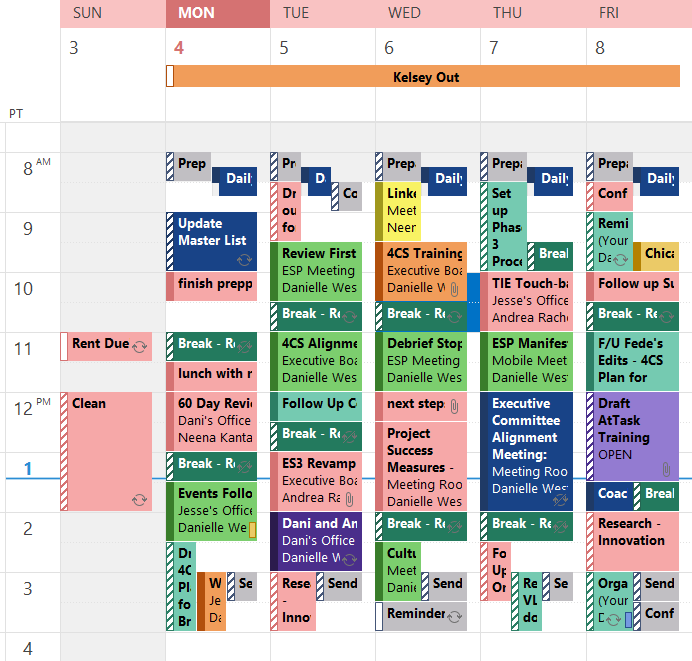
The Outlook calendar can be used to “block off” time to work on tasks that you have that are recurring.  When used in this manner, it becomes an excellent tool for time management.


Identify the recurring tasks that you have and set them up in a way that makes sense.  Be sure to always block the time as tentative so that others can schedule important meetings with you.  A key to using this strategy, is that the blocks of time can be moved around as needed to make way for important items that come up.  

Recurring appointments can be set to repeat every week day or on the last Friday of the month, for example, so set them in a way that is most effective for you.  

Using colors for specific types of meetings and/or reminders can be very helpful too.  For example, self-reminders can be gray.  Big meetings that you run can be green.  Internal regular status meetings can be orange.  Working on your goals can be a dark blue.  Set up colors that make sense and are meaningful for you. 

Suggestions of reminders to set in your calendar:
  1. Filing (perhaps every two weeks for 1 hour)
  2. Meeting preparation (a built in 30 minutes prior to any regular recurring meetings you have)
  3. Goals (set aside at least 2 hours per week to work on your goals – don’t let “tasks” get in the way of true progress)
  4. Report preparation – such as status report for your manager (perhaps 1 hour every week, morning of meeting with manager)
  5. Recurring processes that you have daily (such as 1 hour for filtering resumes; if you find the time is not needed – great!)
  6. Organization session – set aside an hour per week to prep for your next week, make sure all priorities are moving along.  I will train you on this as well.  (Friday is a great day for this)
  7. Tickler file follow up – If you have a follow up folder that you keep (which is a great idea), schedule an hour or so per month to go  through and clean out what you can, follow up on things that should be done by now.  *tip – save emails that you send to this folder as well if you want to make sure something important was completed.

Tuesday, April 28, 2015

Conscious Capitalism Conference - Chicago


Why We Were There and How We Prepared

Earlier this month I had the privilege of attending the Conscious Capitalism Conference in Chicago.  15 people total went from my company, VMBC.  Most of the attendees were from our management team and most had flown in from Buenos Aires, Argentina. 

We went there to radically participate in the Conscious Capitalism event, to learn as much as we could, and to bring back content to share with our teams at home.  We spent the week prior to the event preparing to make sure we all had questions we were seeking to answer which would apply to our specific teams, picked out a schedule of topics that was appealing to us individually, and engaging on the online platforms. 

The questions I sought out to answer were:

1.      As we define our culture as an organization, what techniques can we adopt to genuinely engage our team, inspire each to find their purpose, and encourage growth for everyone?

2.      How can we apply these techniques as best practices for coordinators to make a positive daily impact for all teams?

My Experience

Most of us arrived on Monday.  Michael Kovach and I were the last to arrive and had flown out on the same plane together.   We met the rest of the team at Billy Goat Tavern – the restaurant famous for the SNL skit where Jim Belushi says “Cheeseborger Cheeseborger Cheeseborger”. J   It was this little hole in the wall from outside – the entrance was underground.  We had a great time together eating cheeseburgers and chips.  We walked for about 20 minutes in downtown Chicago and took a lot of pictures.  It was beautiful!

Tuesday around noon our team met up to each record the questions we were seeking to answer on video.  Austin from Round Table Companies joined us for the entire event to create a write up of our experience.  She managed to score us a private boardroom to use for the event so we all met there. 

The conference kicked off on Tuesday afternoon.  One of the quotes given by a host of the event immediately resonated with me, “The world is full of beauty when the heart is full of love.”  I instantly felt excited for what we were about to experience.

 
Tuesday was mostly keynote speakers. 

·        We heard from author Tony Schwartz who helped bring awareness to the fact that stress is good for us when it is balanced with renewal.  I was heavily hit with the realization that I have plenty of stress in my life but need more balance when it comes to renewal.  My takeaway from this was to start sleeping a little more each night (at least 7 hours) and to schedule in a couple of 20 minute breaks during my day. 

·        Another key point that Tony made which stuck with me was about opposites.  He said that each opposite has a positive opposite.  For example, compassion when overused becomes indulgence.  The balanced opposite is self-care.  We should seek value in the opposites we undervalue.  The best leader is the one who holds opposites most gracefully.”  They see deeper and exclude less; they become more conscious. 

·        Next up was author Simon Sinek.  Everyone that I spoke to was very inspired by his talk.  He has a way about him that is very intriguing and straight forward.  He’s refreshing.  He talked to us a lot about behavior, what makes people feel good, and leadership.  What stood out most to me were his points about leadership.  He shared the idea that leadership is not a rank, it’s a behavior that some of us have.  Leadership requires the practice of putting the lives of others before our own interests.  Consistency is way more important than intensity.  A safe environment for your team is key.  Be the leader you wish you had.” 


·        Bob Chapman closed out the day with an amazing talk.  He is the CEO of Barry Wehmiller and brought real life experience to share with us which was really inspiring.  He also focused a lot on leadership and highlighted communications as being a key part of people care.  Leadership is the stewardship of the lives entrusted to you.”  He told us how with communications training and caring about how he touched people’s lives, he is able to lead an organization of over 8,500 people in a way that is deeply inspiring.  He has merged over 70 small companies to become one big happy family by using a formula that has proven successful.  He highlighted the power that business has to be a force for good.  When people spend over 40 hours per week at work, making this time fulfilling for them is critical.  He told us how he has managed to truly accomplish that.

·        Bob shared his 10 keys to a people-centric culture:

1.      Begin every day with a focus on the lives you touch.

2.      Leadership is the stewardship of the lives entrusted to you.

3.      Embrace leadership practices that send people home each day safe, healthy, and fulfilled.

4.      Align all actions to an inspirational vision of a better future.

5.      Trust is the foundation of all relationships – act accordingly.

6.      Look for the goodness in people and recognize and celebrate daily.

7.      Ask no more or less of anyone than you would of your own child.

8.      Lead with a clear sense of grounded optimism.

9.      Recognize and flex to the uniqueness of everyone.

10.   Always measure success by the way you touch the lives of people.

Tuesday night we all had dinner in the hotel together (all meals were included in the event).  It was rainy outside and I felt tired so I went back to my room and typed up my notes.  I knew too much information would be lost if I didn’t!

Wednesday morning a few of us woke up super early and did yoga in a class lead by Manduka.  The class was super packed and a little too challenging for me since I’m pregnant.  I hung in there and felt amazing that morning! 

For a full day on Wednesday we were able to attend a lot of practicums.  We were able to select from about 5 topics at any given time.  Each one that I attended was absolutely amazing.  Here are some highlights:

·        I was sure to catch more from Tony Schwartz.  Tony’s energy audit was kind of depressing to be honest, but also gave me clear insight on what exact adjustments I need to make.  I realized I’m depleting my energy too much and the motivation to improve my behaviors was one of my key realizations of the day.

·        Bob’s Chief People Officer, Rhonda Spencer, spoke about how they do what they do and it was incredible.  They walked through challenging leadership situations and how to turn them around.  She was a great example of a successful woman which I really enjoyed seeing.  I left really wanting to take their communications training ASAP!

·        Finally I watched a session where Simon and Bob spoke together.  We learned more about leadership and left feeling more inspired.  Practice being the last to speak.

That night there was a dinner exercise.  After we ate, each table opened up a donut box filled with supplies.  We were challenged to make a stakeholder model in groups of 8 or so.  We had a blast being creative and competitive.  We cheered louder than we should have and were extremely proud of our creation.  We ended up getting second place.  We definitely were the most creative but the winner had a standout idea – all stakeholders were connected with each other as well as us. 

Thursday was the final day of the conference and it was just a half day through lunch.  The day started with a touching keynote from Melissa Reiff, CEO of the Container Store.  She spoke a lot about communications.  She moved me to the point where I got emotional.  It was a pleasure to hear her experience and see how she’s made an impact on so many.  Here are her 15 characteristics of a leader:

1.      Security – Know you deserve to be seen as who you are.  Have the security to see the best in others. 

2.      Confidence – Ability to dig deep and not be intimidated.  Humility. 

3.      Positive attitude – Make the choice to be happy.

4.      Maturity – Life isn’t the way it’s supposed to be – it is the way it is.  The way you cope with it makes the difference.  Listen, learn, and then react. 

5.      Focus – The ability to zero in and focus on one thing.  Prioritize accurately.

6.      Courage – Never be afraid to show vulnerability.  Work hard to understand and figure out how to bring others with you. 

7.      Sweet – Sincere, thoughtful, generous at heart.  Put others first.  Be caring enough to connect with different types of personalities.

8.      Communication – Open, transparent, caring enough to be thoughtful with approach.  Anything can be solved with dedication to communication.

9.      Tenacity – Never give up. Take responsibility whenever you have the opportunity to do so.

10.   Humor – One of the brightest lights in lie.  Never forget to laugh.  Laugh with others.  Be adventuresome.  “Laughter is an instant vacation.” –Milton Borough

11.   Agility – keeps us alert and nimble.  Challenges us to be strong/on edge.  Trailblazer. 

12.   Creativity – Ignites our passion.  Keeps us youthful. 

13.   Commitment – Without it we sit in limbo.  One of real dangers in life is lack of commitment.  As soon as we commit, the universe conspires to assist you. 

14.   Inspiration – One of the greatest gifts can give self and others. 

15.   Passion – For life and all you do. 


Thursday afternoon my team met for several hours to debrief what we learned.  At this point we were exhausted and were getting stir crazy in the hotel.  I think most of us were reluctant to go into another meeting room, but we were all surprised at how amazing we connected.  We shared what stood out to us most and collaborated in a way that I never have before.  We talked about how we can apply what we learned and how we can share it with our teams back home.  We all connected on another level and although we had different opinions, ended up coming to common ground.  You can view a full copy of our team notes here. 

That night we finally got out of the hotel!  We all went to dinner at Mike Ditka’s Restaurant and had a great time.  We continued to talk about what we learned and connect with each other.  After dinner, some of us walked back to the hotel so we could have one last view of downtown Chicago.  I walked through Millennium Park and saw the famous bean as well as the beautiful architecture of large buildings.

Friday morning we continued going through what we learned and our CEO, Jesse Crowe, called in to join us.  He had to fly out Thursday morning to attend an interview for the ACG Corporate Growth Awards.  Our company is nominated for most innovative company in Orange County!  After Jesse joined the call, we all focused more on an individual level about how we would apply what we learned starting Monday when we returned to work.  We continued to detail out our action plans until we had to hop in our taxi’s and head for the airport.


Summary

The entire experience was amazing.  I realized on a greater level that we already have a beautiful culture at VMBC.  We also have so much potential.  By having so many people attend, we have a critical mass that can bring these realizations to everyone in our team.  We were able to bond, connect, and collaborate on a whole new level.  I’m so excited to see how this year progresses as we continue to develop our culture and engage with the Conscious Capitalism movement. 


Answers I Found to My Questions

1.      As we define our culture as an organization, what techniques can we adopt to genuinely engage our team, inspire each to find their purpose, and encourage growth for everyone?

a.      Share with the management team where we are at in our culture journey and invite their ideas for our action plan.

b.     Invite each manager to submit ideas about our purpose.

c.      Create a leadership best practices to provide consistent leadership to all team members that applies what we learned here.

d.     [I learned a lot of details about how we should modify our culture action plan and made those adjustments.]

2.      How can we apply these techniques as best practices for coordinators to make a positive daily impact for all teams?

a.      Create Project Management best practices that help create structure and balance for projects to reduce the amount of time they take and make them more efficient. 

b.     Make calendar changes that build renewal periods into our schedules as well as for the managers.

c.      Create meetings improvements which encourage playful participation to follow our golden rules and find creative ways to free up time. 

d.     Apply the leadership best practices to our teams.


Please let me know if you have any comments! J